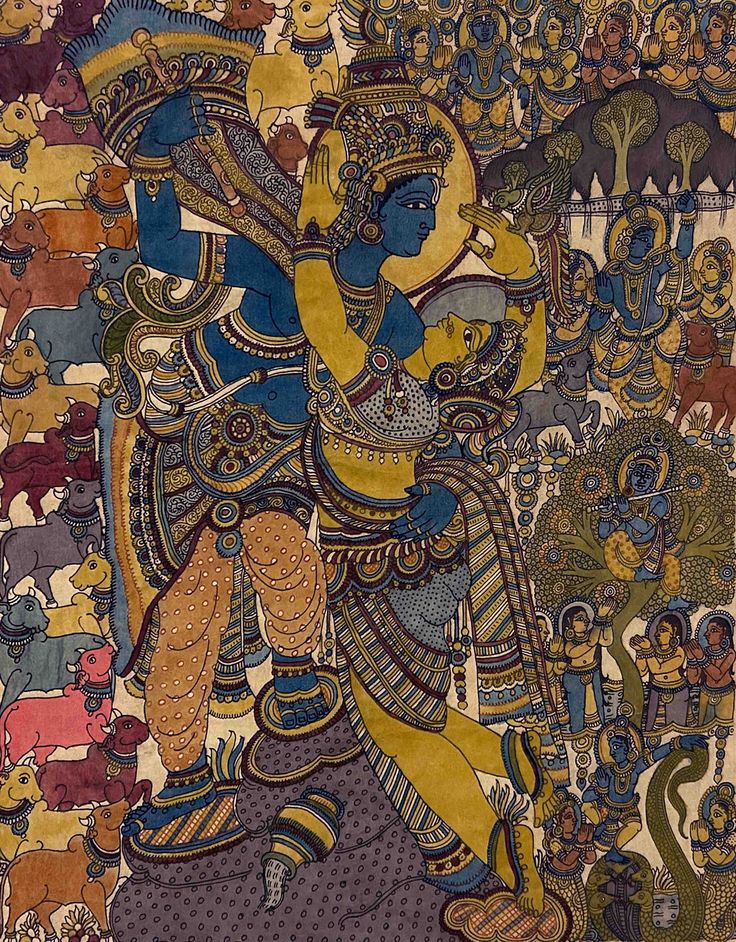
Imagine a piece of cloth so valuable that it sparked international trade wars, dressed the royalty of the mighty Chola Empire, and required months of meticulous painting with a hand-carved bamboo reed. This is Kalamkari, an ancient Indian textile art. To the untrained eye, it looks like a beautiful, traditional design. To the art historian, it is a battlefield of definitions. Calling Kalamkari “folk art” is not just an understatement; it is a fundamental misunderstanding of its history. From its origins as sacred visual scripture under South Indian kings to its status as a luxury global powerhouse, Kalamkari shatters the Western definition of a casual folk craft.
The Kalamkari Paradigm: Dismantling the Folk Art Myth
What do we mean when we categorise an artistic tradition as “folk art”? In conventional art history, the “folk” label carries a specific, often patronizing subtext. It implies a craft that is rustic, informal, intuitive, born of spontaneous village expression, executed by untrained hands, and isolated from the rigid discipline of academic institutions or global market forces.
Then there is Kalamkari.
To look at a traditional piece of Kalamkari is not to witness a casual village hobby, but to confront a highly disciplined masterclass of design. It is an art form requiring 23 separate stages of advanced organic chemistry, meticulous alignment with millennia-old structural design manuals, and centuries of capitalization by dominant historical empires. Calling Kalamkari “folk art” is an analytical failure.
From its ancient origins as a sacred visual scripture to its evolution as a high-value currency of international trade, Kalamkari shatters every parameter of the folk label.
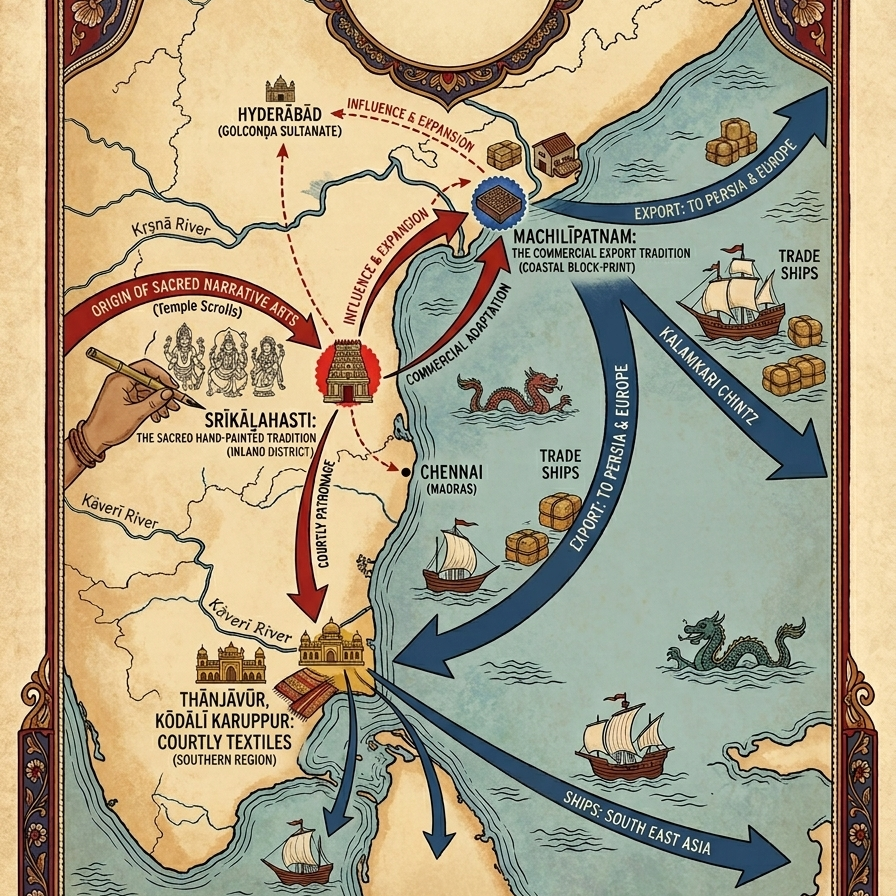
THE CHRONOLOGY OF EMERGENCE: FROM NOMADIC SCROLLS TO IMPERIAL POWER
Kalamkari did not develop overnight in backyard isolation. Its multi-millennial historical trajectory tracks a deliberate path through shifting imperial and cultural power.
The tradition began with the Chitrakars, nomadic painters and oral storytellers who traveled between ancient villages. They unrolled large, hand-painted textile scrolls against temple walls or banyan trees to illustrate the epic narratives of the Ramayana and Mahabharata.
However, the definitive transition from a mobile storytelling medium into a highly structured, professionalized discipline occurred under the Chola Dynasty (9th–13th century CE). The Cholas institutionalized the craft, integrating painters directly into state-administered temple complexes.
Centuries later, the Vijayanagara Empire and the Deccani Sultanates patronized the medium. They infused it with Persian floral aesthetics and renamed it Qalamkari from the Persian words kalam (pen) and kari(craftsmanship). By the 17th century, European maritime empires became so consumed by the material’s unparalleled colorfastness that they transformed it into a global trade currency.
STRUCTURAL GEOMETRY: THE TYRANNY OF THE SHILPA SHASTRAS
Folk art is typically celebrated for its naive perspective, subjective distortions, and spontaneous execution. Traditional Kalamkari, specifically the freehand Srikalahasti lineage operates under a diametrically opposed reality. The artist’s hand is strictly governed by the Shilpa Shastras, the ancient Sanskrit technical manuals that dictate Hindu iconography, sculpture, and temple architecture.
Under these canonical texts, drawing a divine entity is an exercise in rigorous mathematics rather than personal whim. The artisan must adhere to precise geometric grids and proportional systems (Talamana).
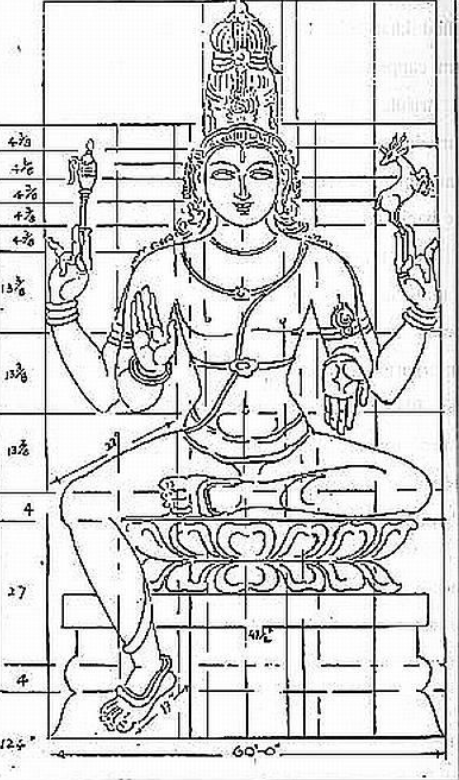
- The Grid System: Deities cannot be drawn free-form; they are mapped on modular grids where specific body parts correspond to exact unit measurements (Angulas).
- Anatomical Legality: The width of an eye, the specific curvature of a torso, and the orientation of the feet are strictly codified based on the deity’s metaphysical state (such as Rudra, the wrathful, versus Shanta, the serene).
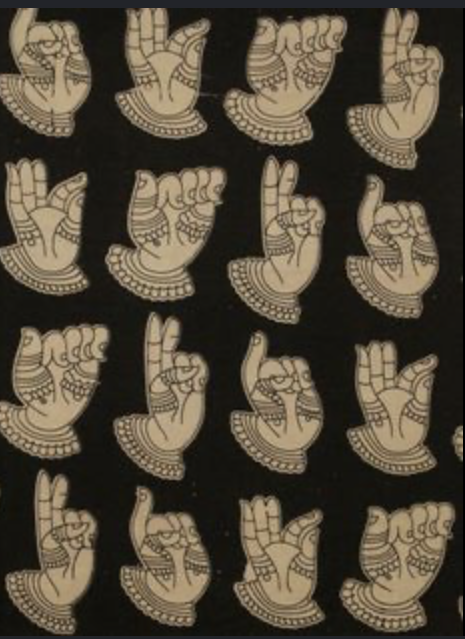
- The Language of Mudras: Hand gestures (mudras) are not decorative poses. They are highly specific legal and theological statements that must be executed with millimeter precision to convey precise philosophical meanings.
This intense, intellectual discipline requires years of formal, master-apprentice training. It functions as an academic art academy system that mirrors the classical rigour of European Renaissance workshops.
ECONOMIC INTEGRATION: THE CHOLA STATE ADMINISTERED TEMPLE SYSTEM
The “folk” label implies an art form created outside formal economic systems, built primarily for domestic or local village utility. Kalamkari’s history breaks this assumption. During the height of the Chola Empire, textile painters were not isolated village creators; they were formal professionals inside a massive state-administered temple economy.
Chola temple towns, like Thanjavur and Kanchipuram, operated as corporate financial hubs. The royal court issued explicit edicts allocating permanent land grants, grain rations, and tax exemptions specifically to artisan guilds including the Saliyar weavers and cloth painters.
These artisans were salaried institutional employees tasked with producing massive textile architecture: painted canopies, enormous processional drapes for temple chariots, and sacred deity backdrops. This system was highly bureaucratic. The production of these textiles was treated as a vital civic and state responsibility, completely distinct from the informal bartering of folk craft.
COURTLY MATERIAL LUXURY: THE SECRET OF KODALI KARUPPUR
Perhaps the most definitive blow to the folk label is the legacy of Kodali Karuppur textiles. Originating in the Thanjavur region during the Chola era and reaching its zenith under the Maratha rulers in the 18th century, Karuppur Kalamkari was engineered exclusively as a luxury status symbol for the global elite.
This was a highly complex, hybridized textile art that combined expert weaving with meticulous hand-painting.
- The Royal Blueprint: The process began by weaving fine cotton or silk with intricate brocade patterns using pure gold and silver threads (Zari or Vani).
- The Painted Overlays: Artisans then used palm-leaf and tamarind twigs to paint elaborate mordant patterns around and over the metallic threads.
- The Imperial Currency: These cloths were designated as Khillat: royal garments of honor exchanged exclusively between emperors, sultans, and foreign ambassadors.
The Maratha nobility used Karuppur textiles for royal sarees, turbans, and palace curtains. When an art form is engineered through costly materials to serve as a literal currency of royal prestige, reducing it to a rustic folk craft is historically illiterate.
MOLECULAR CHEMISTRY: THE 23-STEP LABORATORY WORKFLOW
If the historical and economic realities do not distance Kalamkari from folk art, its science certainly does. Folk crafts typically use raw natural materials with minimal transformation. Traditional Kalamkari relies on a rigorous, highly volatile 23-step workflow that functions entirely on advanced organic chemistry and molecular binding.
The artisan does not simply apply pigment to cloth; they act as a laboratory chemist.
- The Enzyme Mordant Coating: The raw cotton fabric (Gaada) is saturated in a solution of crushed Myrobalan fruit (Karakkayal) and fresh buffalo milk. The fat enzymes in the buffalo milk coat the cellulose fibers of the cotton, creating a natural chemical barrier. Without this specific lipid coating, subsequent natural dyes would bleed across the fabric fibers via capillary action.
- Fermented Iron Synthesis: The black ink (Kasim Kaaram) is produced through a deliberate chemical reaction. Iron filings and scrap metal are fermented with palm jaggery and sour water inside airtight clay pots for over 21 days. The resulting iron acetate reacts instantly with the tannins in the pre-treated Myrobalan cloth, yielding an intense, permanent jet-black molecular bond that never fades.
- Chromatographic Boiling: To develop the deep reds, the fabric is boiled with madder root (Surudu Chekka or Alizari) at highly controlled temperatures. Alum (aluminum sulfate) is carefully introduced as a secondary metallic mordant to lock the red dye molecules permanently into the fabric’s core matrix.
One minor miscalculation in water alkalinity, boiling duration, or enzyme fermentation time shifts the chemical balance, completely ruining the entire textile. This is an unforgiving, hyper-precise material science.
INDUSTRIAL SCALE: THE ENGINE OF GLOBAL MARITIME TRADE
The final parameter of the folk label is geographic isolation and a lack of commercial scale. Kalamkari, under its European trade name “Chintz,” was a dominant global economic powerhouse.
During the 16th to 18th centuries, the industrialized world became obsessed with Coromandel Coast printed textiles. The British, Dutch, and Portuguese East India Companies set up massive trade factories to export these fabrics by the millions.
This was not a casual village industry. Kalamkari workshops operated as highly organized, multi-tiered industrial centers. Artisans managed complex production lines and systematically adapted their traditional design templates to cater to changing European high-society fashion and luxury upholstery markets. The global demand for Kalamkari was so overwhelming that it sparked protectionist trade laws across Europe, as domestic Western textile mills simply could not compete with the sophisticated quality of Indian chemistry.
REWRITING THE NARRATIVE
The term “folk art” is an analytical dead end when applied to Kalamkari. By anchoring itself in the rigid geometric laws of the Shilpa Shastras, operating as the financial engine of the Chola temple economy, styling the elite nobility via Karuppur textiles, and executing complex molecular chemistry, Kalamkari proves itself to be an elite, highly sophisticated discipline.
Continuing to label this textile masterpiece as a casual folk craft diminishes the profound scientific, economic, and academic genius of ancient Indian design. It is time for art history to discard these outdated colonial definitions and recognize Kalamkari as the sophisticated intellectual achievement it has always been.
REFERENCES
- Laasya Art Gallery Archives. (2026). Kalamkari: The Traditional Indian Art of Perfection and Iconography. Laasya Art Repository.
- Deepthi, B. C. (2024). The Science Behind Kalamkari Art: Traditional Textile Methodology Framed in Modern Chemistry. Deep Science Research Journal.
- Forbes India Heritage Report. (2023). How the Intricate Motifs of Karuppur Kalamkari Paintings Transcend Time. Forbes India Culture and Heritage Feature.
- Memeraki Cultural Repository. (2025). Kalamkari: Timeless Hand-Painted and Printed Textile Artforms of Ancient India. MeMeraki Craft Documentation.
- ResearchGate Textile Review. (2025). Kalamkari: The Story of Hand-Painted Chintz Fabric from the Coromandel Coast. ResearchGate Publication Archives.
- Sastri, K. A. Nilakanta. (1955). The Cōḷas. University of Madras Press. (Historical documentation regarding the administrative and economic structure of South Indian temple craft guilds).
- Textile History Archives. (2022). The Material Science, Mordants, and Organic Processing of Traditional Kalamkari Fabric. Prosperity Mirra Technical Library.