01: VASTU SHASTRA – PILLARS OF INDIAN DESIGN

Indian civilisations gave the world mathematics, town planning, sex, art, and a science of architecture that tracked magnetic fields and solar radiation millennia before the West developed instruments to measure them. Vastu Shastra is one of its most complete expressions.
Vastu Shastra literally translates to the ‘science of architecture’. It is one of the primordial Indian architectural design philosophies. It believes in an holistic approach of creating spaces that enhances the quality of human living by encompassing the principles of nature and cosmic energies. Dating back to 1500–1000 BCE, they seem to have roots from the ancient Vedas, especially Rig Veda and Atharva Veda where earliest concepts of cosmic planning and placing structures in harmony with natural elements were recorded. Vastu Shastra functions as a highly disciplined system grounded in the mechanics of solar radiation tracking, electromagnetism, geobiology, cosmology and aerodynamic equilibrium.
CORE PRINCIPLES AND FOUNDATIONS
This science consists of the five natural elements (Air, Water, Earth, Fire and Space) which are referred to as ‘Pancha Mahabhutas’. These Mahabutas are associated with certain directions based on their coherence with different aspects of cosmic energies.
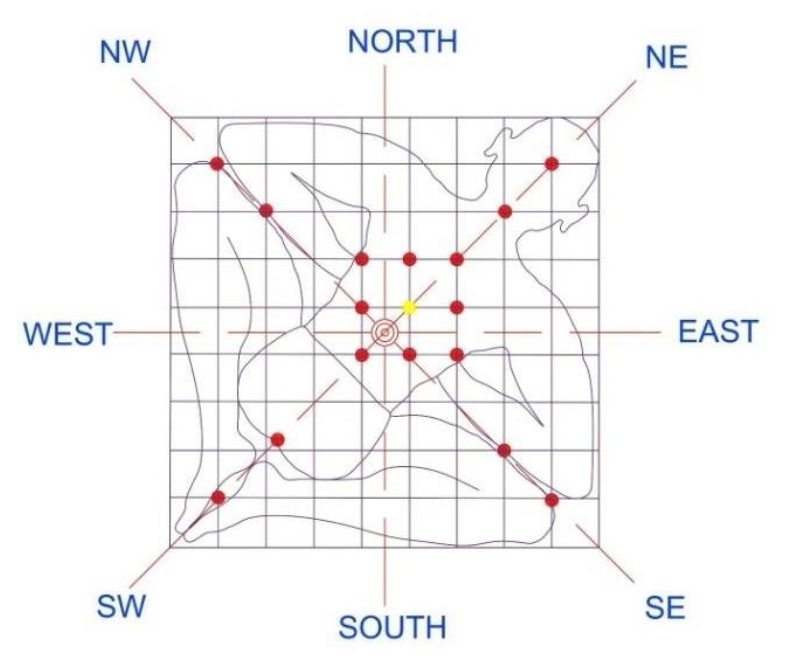
This system exists both in human and buildings. The study and comparison of the systems of humans and buildings together is called Vastu Purush as shown in the diagram above. Mythology describes Vastu Purusha as a heavenly being that watches over the structure and shields its occupants from harmful forces.
The Vastu Purusha Mandala, a grid-like structure that maps out the body of Vastu Purusha, is thought to guide the arrangement of rooms and elements in a building. Marmsthanas, represented by solid red dots in the figure above, are the precise locations throughout Vastu Purusha’s body where vital energy, or prana, is concentrated. Understanding Marmsthan is crucial for architectural design since it affects how different components are arranged within a structure.
According to Vastu philosophy, there are two opposing forces that can be classified as positive and negative, respectively. Pranik and Jaivik Urja, vital and natural energy, are released throughout the Earth’s surface as a result of these forces interacting. “Pranik” energy, which is frequently associated with breath or vitality, represents the life force that gives living things life. On the other hand, “Jaivik” energy includes all of the natural energies found in the surroundings, such as those from the sun, wind, water, and earth. These energies are essential to maintaining ecosystem equilibrium and supporting life. The normal flow of energies is disturbed when a building is built, allowing both positive and negative forces to enter.
However, a building’s size, shape, slope, elevation, structural components, closeness to bodies of water, and the arrangement of its rooms, doors, and openings all affect how intense and balanced these energies are.
Vastu Shastra emphasizes how crucial it is to arrange architectural elements in a way that maximizes the flow of positive energy, creating settings that promote wellbeing. Prioritizing good forces in a building’s design encourages the release of healthy bioenergy, which improves everyone’s health. Structures that prioritize positive forces preserve an abundance of positive cosmic energy even in the face of negative influences, guaranteeing a peaceful and satisfying existence. On the other hand, structures that support negative forces diminish the bio-energy field, which may lead to health problems and a gloomy perspective.
BEYOND THE MYTH: SCIENTIFIC SUBSTRATES
Vastu Shastra is far more than a collection of spiritual superstitions; it is an ancient Indian architectural science engineered to align human habitats with the laws of nature. By treating a building as a living organism, Vastu uses spatial geometry to harness invisible environmental forces – such as solar radiation, geomagnetism, and thermodynamics – to optimize human health, productivity, and peace of mind.
Here are the key scientific elements that form the blueprint of Vastu Shastra:
1. SOLAR GEOMETRY (SOLAR PRANIC FLOW)
Vastu treats the Sun as the primary driver of life and vital energy (Prana). The rules of room placement are directly dictated by the Sun’s daily trajectory and the changing quality of light throughout the day:
- The Morning Purifier (East to Northeast): Early morning sunlight is rich in life-giving ultraviolet rays that synthesize Vitamin D and naturally disinfect spaces. Vastu places main entrances, verandahs, and study rooms in the East to flood the interior with this morning light.
- The Midday Thermal Peak (South): By afternoon, the Sun casts intense, harsh infrared radiation. To prevent the home from overheating, Vastu dictates making Southern and Southwestern walls thicker, with fewer or smaller windows, acting as a thermal buffer.
- The Evening Fade (West): Evening light is considered dormant. Western zones are reserved for activities that require less life-force energy, such as storage, toilets, or dining areas.
2. GEOMAGNETIC ORIENTATION (THE POLAR ALIGNMENT)
The Earth acts as a massive magnet, with continuous lines of magnetic force flowing steadily from the North Pole to the South Pole. Vastu architecture is designed to synchronize the human body with this planetary magnetic field:
- The Sleeping Direction Rule: Vastu strictly advises against sleeping with your head pointed toward the North. Biologically, the human body carries its own subtle magnetic field, with the head acting as the positive pole. Pointing your head North creates a magnetic repulsion with the Earth’s field, which can disrupt blood circulation, increase blood pressure, and cause restless sleep.
- The Axis of Prosperity: Aligning a building’s major axes with the North-South grid allows the Earth’s magnetic currents to flow through the structure uninterrupted, fostering mental clarity and cognitive focus for the inhabitants.
3. COSMIC GEOMETRY (VASTU PURUSHA MANDALA)
When a plot of land is enclosed by walls, it captures a distinct pocket of cosmic energy. Vastu maps this energy using a precise, mathematical 81-square grid called the Vastu Purusha Mandala:
- The Energy Nexus (Northeast): The Northeast corner is the exact junction where the Earth’s magnetic currents intersect with the morning solar waves. This makes it the zone of highest energetic purity (Ishaan), reserved for meditation, prayer, or clean water features.
- The Neutral Core (Brahmasthan): The geometric center of the grid represents the nucleus of the structure. Vastu mandates that this central space must remain entirely open, unburdened by heavy walls or pillars, allowing energy to circulate freely and radiate into surrounding rooms.
4. MICROCLIMATE AND THERMODYNAMICS
Vastu functions as an ancient system of passive climate control, meticulously accounting for wind patterns and indoor airflow:
- Cross-Ventilation: In the Indian subcontinent, cool, refreshing breezes predominantly travel from the North and East. Vastu places large windows and balconies in these directions to welcome fresh air, while keeping the hotter, heavy South-West sides relatively closed.
- The Element of Fire (Southeast): The Southeast corner is designated for the kitchen because it naturally balances the thermodynamic forces of the home, ensuring that heat-generating activities do not disrupt the cooler, resting areas of the house.
CONCLUSION
Modern architecture gave us glass, steel, and buildings that look like the future. It also gave us spaces that exhaust us, disorient us, and make us subtly unwell without knowing why. Vastu Shastra was not superstition. It was the operating manual we threw away. The symptoms we live with daily are the buildings asking us to find it again.
CITATIONS
[1] CLASSICAL TEXT: Mayamata / Manasara (Treatises on Vedic Spatial Geometry) — Deconstructs the mathematical proportions of the 8×8 Manduka grid matrix.
[2] ARCHAEOLOGY & MATHEMATICS: Kak, S. (2005) “Vastu and the Geography of Sacred Space” — Details the archaeoastronomical alignment of ancient Indian town planning.
[3] Scientific Substantiation of Vastu Shastra (2024) Piyush D. Patel1*, Piyushkumar J. Patel2